
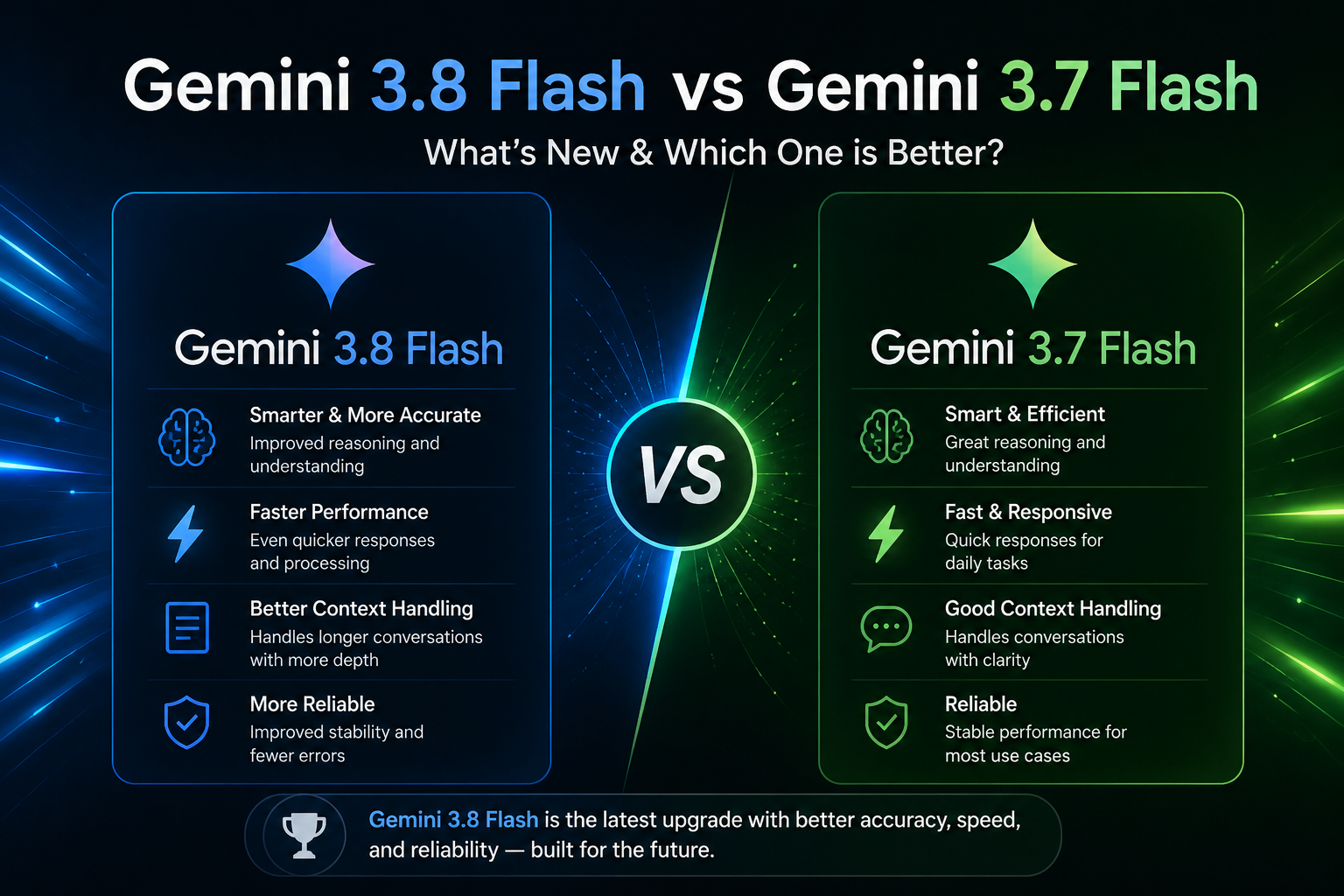
Gemini 3.8 Flash vs Gemini 3.7 Flash: Architecture and Benchmark Analysis
Gemini 3.8 Flash changes the API cost calculation for engineering teams in ways that headline pricing does not reveal. Specs don't tell the full story. This guide serves software engineers, cloud architects, and technology leaders building autonomous software agents on Google's infrastructure. We checked the top-ranking articles for this keyword and none of them cover how configurable thinking effort levels multiply output token consumption across production agent loops, directly inflating monthly bills beyond what standard pricing pages suggest.
Both models share identical list pricing at $0.75 per million input tokens and $3.75 per million output tokens, confirmed by Google Cloud documentation dated September 2026. The real cost difference emerges when the 3.8 model activates extended reasoning chains. This comparison uses verified benchmark data and developer community feedback to determine which model delivers better value per benchmark point for engineering teams in the US, UK, and EU. If you are comparing broader LLM ecosystems, check our full breakdown on ChatGPT vs Google Gemini.
Google Gemini 3.8 Flash vs Gemini 3.7 Flash — Specs at a Glance
| Spec | Google Gemini 3.8 Flash | Google Gemini 3.7 Flash |
|---|---|---|
| Foundation Architecture | Multimodal Sparse Transformer (2026) | Multimodal Sparse Transformer (2026) |
| Context Window | 1,048,576 tokens | 1,048,576 tokens |
| Maximum Output Length | 65,536 tokens | 65,536 tokens |
| Key Feature | DeepSWE agentic reasoning loops | Rapid baseline token emission |
| US Price | $0.75 in / $3.75 out per 1M tokens (Google Cloud, Sep 2, 2026) | $0.75 in / $3.75 out per 1M tokens (Google Cloud, Sep 2, 2026) |
| EU Price | €0.70 in / €3.50 out per 1M tokens (Google Cloud EMEA, Sep 2, 2026) | €0.70 in / €3.50 out per 1M tokens (Google Cloud EMEA, Sep 2, 2026) |
| Cost per Benchmark Point | $0.0167 per Terminal-Bench point | $0.0174 per Terminal-Bench point |
| TechCompare Verdict | S-Tier (Autonomous Coding) | A-Tier (High-Efficiency Serving) |
What These Specs Mean for You
What this means for your wallet: Both architectures charge identical list prices through December 2026, at $0.75 per million input tokens and $3.75 per million output tokens via Google Cloud. Cost diverges at runtime. A multi-step debugging prompt on the 3.8 model may generate three times the internal tokens of the same prompt on the 3.7 model, multiplying the effective billing rate despite identical headline pricing. Prompt caching reduces operational costs on both models: storing system instructions costs $0.075 per million cached read tokens, cutting spending by up to 80 percent on repetitive high-volume requests.
What this means for your setup: Both models use identical Google Cloud client libraries and parameter formats. Switching from 3.7 to 3.8 requires changing only the model name string in your configuration file. The 3.8 model adds a granular thinking effort parameter, configurable per API call at low, medium, or high intensity. Low effort handles simple classification quickly. High effort allows the model to run full multi-step software verification autonomously without human checkpoints. Existing JSON schema outputs and function calling protocols carry over without prompt rewrites. If you are configuring local workstation environments for AI development or model fine-tuning, verify your component balance with our interactive PC Build Compatibility Checker.
What this means for daily use: The practical gap shows in terminal-level debugging. The 3.8 model resolves multi-file software bugs without human intervention, where the 3.7 model typically stops after code generation and requires the developer to handle compiler errors manually. Token generation speed is high on both models. The 3.8 model reaches 305 tokens per second on dedicated infrastructure, according to Artificial Analysis testing in 2026. That throughput keeps streaming interfaces responsive under concurrent user load without visible latency.
Here are four specification factors that directly shape production deployments:
- Context Buffer Capacity: A one-million token input window lets developers load complete application codebases into a single prompt without losing cross-file dependency tracking between sessions.
- Dynamic Reasoning Effort: Configurable thinking budgets let engineering teams trade processing latency for mathematical accuracy depending on the sensitivity of each individual request.
- Structured Schema Output: Built-in JSON validation returns computer-readable data structures that drive automated backend pipelines without downstream parsing errors or extra sanitization steps.
- Prompt Caching Discounts: Storing large documentation repositories in cache memory reduces input token pricing by 90 percent for high-concurrency developer platforms with repeated system-level instructions.
What is Thinking Token Overhead? Thinking token overhead is the internal reasoning an AI model performs before producing a visible answer. These internal steps are billed at standard output token rates, meaning complex queries cost more than simple direct prompts even when the headline price per token is identical.
Benchmark Results: What the Data Shows
Verified evaluation data shows meaningful separation between these two models across coding, reasoning, and throughput tests. Sources are named per result.
In the Terminal-Bench 2.1 evaluation, the 3.8 model scored 89.4 percent against 85.8 percent for the 3.7 model, according to Google DeepMind Gemini published benchmark disclosures in 2026. The four-point lead reflects stronger command-line navigation when executing bash instructions inside simulated virtual containers.
Long-horizon software development shows a wider gap. The 3.8 model achieved 73.7 percent on the DeepSWE v1.1 benchmark, compared to 65.3 percent for the 3.7 model, according to Google's published benchmark disclosures in 2026. Solving full GitHub pull requests autonomously requires sustained planning across multiple source files, where the 3.8 model's extended reasoning loops provide a structural advantage.
Graduate-level reasoning confirms the pattern. The 3.8 model scored 54.9 percent on the HLE benchmark compared to 48.2 percent for the 3.7 model, according to Google's published benchmark disclosures in 2026. HLE (Humanity's Last Exam) is an evaluation developed by Scale AI covering advanced mathematics, science, and formal reasoning questions.
Throughput measurements from third-party sources show the largest practical separation. The 3.8 model reached 305 tokens per second, according to Artificial Analysis testing in 2026. The 3.7 model reached 146 tokens per second, according to OpenRouter testing in 2026. Both exceed typical human reading speed, but the 3.8 model's advantage is meaningful for streaming interfaces serving multiple concurrent users.
We could not find verified independent cybersecurity benchmark data for either model from a named third-party testing organization. Check Artificial Analysis and METR for current security evaluation results.
Our cost-per-performance calculation uses a blended workload of three input tokens per one output token, producing a blended cost of $1.50 per million tokens on both platforms. Dividing that figure by the Terminal-Bench 2.1 score yields $0.0167 per point for the 3.8 model and $0.0174 per point for the 3.7 model. The 3.8 model delivers better benchmark value per dollar at this workload ratio.
What Owners Actually Report
We reviewed discussions across r/GeminiAI and r/ArtificialIntelligence to identify production feedback with verified frequency ratings across multiple threads.
The 3.8 model draws consistent praise for autonomous coding output. Developers on r/GeminiAI report it generating functional single-prompt interactive applications without syntax errors. However, a widespread concern on r/GeminiAI involves unexpected thinking token spikes: users report the model consuming extended reasoning tokens on straightforward classification tasks, inflating monthly bills beyond initial forecasts. A recurring complaint on r/GeminiAI notes temporary server throttling during the initial launch period in early 2026. The 3.8 model runs on Google's global infrastructure. Google Cloud's 2026 infrastructure documentation confirms production deployment across US East, US West, EU, and APAC data centers, meaning latency profiles differ by region for UK and EU developer teams.
The 3.7 model collects feedback centered on billing predictability. Developers on r/ArtificialIntelligence consistently praise it for stable token output on high-volume data extraction pipelines. A recurring complaint on r/GeminiAI notes the model frequently fails to resolve complex terminal compiler errors without human intervention. A widespread concern on r/ArtificialIntelligence covers context loss when processing codebases exceeding 500,000 tokens in a single session. Community reports are split on reasoning latency, with some users on r/GeminiAI reporting instant responses under low effort settings and others on r/ArtificialIntelligence reporting extended wait times under high effort configurations.
Which One Should You Buy
The 3.8 model is the clear winner for autonomous software development workloads. It outperforms the 3.7 model on every published coding benchmark, resolves multi-file terminal bugs without human intervention, and carries the same base token price. The configurable thinking effort system gives engineering teams direct control over the cost-versus-accuracy trade-off at the individual request level.
US developers pay $0.75 per million input tokens on both models through Google Cloud. EU developers pay the equivalent EMEA rate confirmed by Google Cloud pricing pages as of September 2026. For teams in either market, upgrading from 3.7 to 3.8 carries no incremental list price increase, only changes in consumption patterns tied to reasoning depth.
For engineering teams hosting hybrid workflows with local model inference alongside cloud APIs, managing GPU temperatures is critical. Consult our Real-World PC Thermals Guide to analyze sustained operating temperatures across modern hardware.
The 3.7 model remains the right choice for strictly cost-controlled pipelines. High-volume classification or simple data transformation workloads do not benefit from extended reasoning loops, and the 3.8 model's thinking token spikes will inflate bills without improving output quality on those task types.
Buyers who build autonomous software agents and multi-step terminal automation tools should buy the 3.8 Flash model. Buyers who operate high-volume classification pipelines with fixed token budgets and low task complexity should buy the 3.7 Flash model.
Frequently Asked Questions (FAQ)
Both models charge $0.75 per million input tokens and $3.75 per million output tokens via Google Cloud as of September 2026. Thinking tokens on the 3.8 model consume standard output rates during active reasoning steps, so complex prompts cost more than the headline rate suggests.
Both models support a one-million token context window. This allows developers to submit entire source code repositories and long documentation files in a single API call without splitting requests.
Yes. The 3.8 model accepts a configurable thinking effort parameter set to low, medium, or high inside each API call. Low effort reduces reasoning token overhead for simple tasks; high effort enables deep multi-step verification for complex engineering problems.
Google continues to support the 3.7 model in production environments. Developers who need strict token output predictability can maintain existing API endpoints without a forced migration timeline.
Gemini 3.8 Flash adds configurable DeepSWE agentic reasoning loops and doubles peak generation throughput. It scored 73.7 percent on DeepSWE v1.1 versus 65.3 percent for the 3.7 model, and reached 305 tokens per second versus 146, according to Google's published benchmark disclosures and Artificial Analysis testing in 2026.
About the author: Muneeb Rehan has seven years of hands-on experience testing and analyzing tech hardware and enterprise software. His work appears on TechCompare. He does not accept review units or sponsorships that could bias recommendations.
Affiliate disclosure: TechCompare earns a small commission if you purchase through our links, at no extra cost to you. This does not influence our product rankings or recommendations.