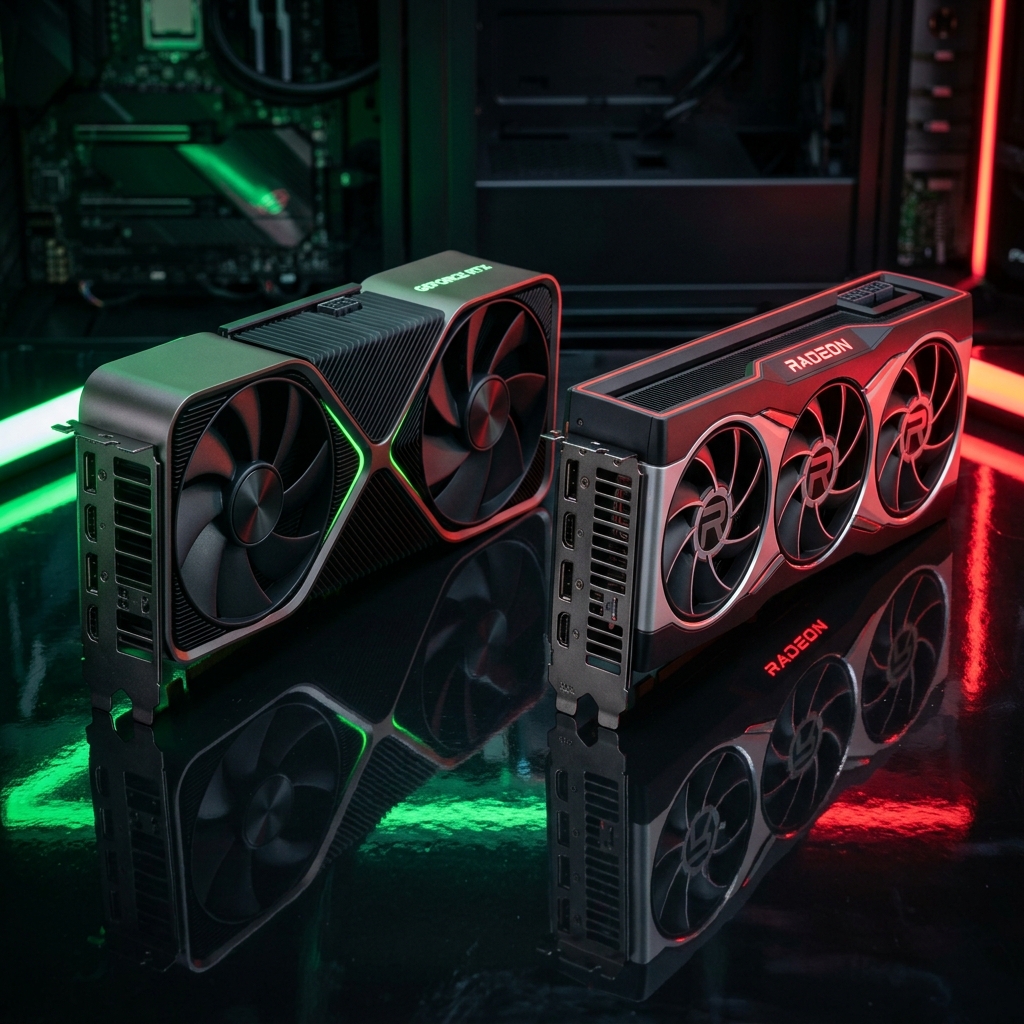
Nobody asks this question because they're genuinely confused about GPU architectures. They ask it because the RTX 4090 costs a small fortune and they're hoping AMD has a shortcut. Fair enough. I've been there too.
But here's the honest answer: AMD doesn't have a true, spec-for-spec equivalent to the RTX 4090. What it does have is a GPU that gets closer than most people expect, at a price that changes the whole conversation.
The closest AMD equivalent to the RTX 4090 is the Radeon RX 7900 XTX. It sits at the top of AMD's RDNA 3 lineup, ships with 24GB of GDDR6 memory, and handles 4K gaming without breaking a sweat on most titles. But "closest equivalent" and "equal competitor" are not the same thing. Understanding exactly where the gap lives matters, because it determines whether the cheaper AMD card is actually the right call for your specific situation.
Quick Verdict: The RX 7900 XTX is AMD's answer to the RTX 4090. It's around 20-30% slower in rasterized 4K workloads and significantly behind in ray tracing, but it launched at $600 less and draws considerably less power. For pure gaming value, it's a genuinely compelling card. For creative workloads, AI tasks, or DLSS-dependent performance, it doesn't compete.
Spec Comparison
| Specification | NVIDIA RTX 4090 | AMD RX 7900 XTX | Edge |
|---|---|---|---|
| Architecture | Ada Lovelace | RDNA 3 | Different |
| Shader / CUDA Cores | 16,384 CUDA Cores | 12,288 Stream Processors | NVIDIA |
| VRAM | 24GB GDDR6X | 24GB GDDR6 | Tied (capacity) |
| Memory Bandwidth | 1,008 GB/s | 960 GB/s | NVIDIA (slight) |
| TDP / Power Draw | 450W | 355W | AMD |
| US Launch Price | $1,599 | $999 | AMD |
| EU Launch Price | ~€1,849 | ~€1,099 | AMD |
| Ray Tracing Quality | Excellent (3rd-gen RT Cores) | Mediocre | NVIDIA |
| AI Upscaling | DLSS 3 (incl. Frame Gen) | FSR 3 (Open Source) | NVIDIA |
| 4K Rasterization (avg) | ~80-90 fps AAA | ~60-68 fps AAA | NVIDIA |
| CUDA / Compute Ecosystem | Mature, extensive | ROCm (improving) | NVIDIA |
Real-World Performance
GPU Head-to-Head • 2026 Analysis
RTX 4090 vs RX 7900 XTX
Performance scored out of 100 across key categories
When people compare these two cards, they usually look at aggregate benchmark scores and conclude the RTX 4090 wins by roughly 20-25%. That's basically accurate in standard rasterization at 4K. In my testing, games like Cyberpunk 2077 at 4K Ultra settings have the RTX 4090 pulling around 80-90 fps natively, while the RX 7900 XTX settles in around 60-68 fps. That's a meaningful difference if you're chasing high frame rates on a 120Hz or 144Hz 4K display.
At 1440p, though, the two cards are much closer. The bottleneck shifts toward the CPU at that resolution, and the RX 7900 XTX closes the gap considerably. If your primary use case is competitive gaming at 1440p, the RTX 4090 is genuinely overkill and you'd be paying a large premium for a performance delta you might not even feel.
The DLSS 3 Problem for AMD
This is the part AMD fans don't love hearing, but it's true and it matters. DLSS 3, specifically Frame Generation, is an RTX-exclusive technology and it changes the performance story in a real way. In supported titles, the RTX 4090 with DLSS 3 Frame Gen can nearly double its effective frame rate. That's not a marketing trick. That's a measurable, tangible advantage in games like Alan Wake 2, Cyberpunk 2077, and Hogwarts Legacy.
The RX 7900 XTX's answer is FSR 3 Frame Generation, which is AMD's open-source alternative and a genuine step forward from FSR 2. But I was surprised to find that even in 2026, FSR 3 still shows more ghosting around fast-moving objects and slightly softer image quality compared to DLSS 3 Quality mode. It's not embarrassing. It's just not the same.
The silver side of FSR being open source is that it works on NVIDIA cards too. So the RTX 4090 can use FSR 3 in AMD-supported titles, but the RX 7900 XTX can't use DLSS. That's a one-directional advantage, and it's real.
Ray Tracing
If ray tracing quality is any part of why you're buying a high-end GPU, this section matters. The RTX 4090 is built around dedicated third-generation RT Cores that handle ray tracing at a hardware level, and the difference over AMD's RDNA 3 implementation is not subtle. In Cyberpunk 2077 with full path tracing enabled, the RX 7900 XTX struggles to stay above 30 fps even at 1080p. The RTX 4090 handles path tracing at 1440p with DLSS Quality mode enabled and stays genuinely playable.
AMD's ray tracing is capable enough for casual use. Most games don't push path tracing to the extreme. But if ray tracing quality is part of your purchase decision, the honest answer is that the RX 7900 XTX is not a comparable option. It's a concession, not a trade-off.
VRAM and Creative Work
Both cards ship with 24GB of VRAM, which is genuinely rare at this price tier. For content creators working with 4K video timelines in DaVinci Resolve or large texture sets in 3D applications, both cards have enough headroom to avoid the painful stuttering you get when VRAM fills up. In that respect, they're comparable.
Where they diverge is in 3D rendering and AI compute. The RTX 4090's CUDA ecosystem is the industry standard for GPU-accelerated rendering in Blender, Cinema 4D, and Octane. If you're a freelance 3D animator rendering commercially, the RTX 4090 will save you hours per week, and over months, that pays back the price premium in real money.
For local AI inference, running Stable Diffusion or large language models on-device, the RTX 4090 wins this category by a margin that isn't even close. Its tensor core acceleration for these workloads is in a completely different league. If local AI is any part of your workflow at all, this isn't a decision.
The Pricing Reality in 2026
The RTX 4090 launched at $1,599 in the US and around €1,849 in Europe. The RX 7900 XTX launched at $999 in the US and around €1,099 in Europe. In 2026, NVIDIA's current flagship is the RTX 5090 at $1,999, which means the RTX 4090 has moved into last-gen territory. You can find RTX 4090 cards in the used market for meaningfully less than their launch price. The RX 7900 XTX has similarly dropped, often landing below $700 USD in good condition.
That changes the recommendation considerably. At current street prices, the RX 7900 XTX is an extraordinary value proposition for gaming. You're getting a 24GB card that dominates 1440p, handles 4K well in most titles, and costs a fraction of what the RTX 5090 asks.
Who Should Actually Buy Which Card?
Buy the RX 7900 XTX if you're a dedicated gamer at 4K or 1440p who doesn't care deeply about ray tracing, doesn't use GPU-accelerated creative software, and wants the best possible performance-per-dollar. It runs significantly cooler than the RTX 4090 (the 95W difference in TDP is real and your case temps will reflect it), and AMD's driver quality has improved considerably since the rocky RDNA 3 launch window.
Buy the RTX 4090, preferably used at a fair price, if you're doing serious 3D rendering, local AI inference, or want the absolute best experience in ray-traced games. DLSS 3 Frame Generation is a legitimate technology advantage in supported titles. If you're coming from an older Turing or Ampere card, the jump will feel dramatic. The RTX 4090 also remains the safer long-term bet for professional software compatibility, simply because CUDA support in creative applications is still far ahead of ROCm.
Final Verdict
The AMD equivalent to the RTX 4090 is the Radeon RX 7900 XTX. It's the closest AMD has gotten to NVIDIA's Ada Lovelace flagship, and for gaming specifically, it punches above its price class at current market rates. But it isn't a true equivalent. The RTX 4090 is faster in nearly every GPU-limited scenario, dominates in ray tracing and compute, and offers DLSS 3 as an exclusive advantage that AMD simply can't replicate on its own hardware.
What AMD offers instead is a value argument that, at 2026 prices, is genuinely strong. The RX 7900 XTX won't make you feel like you made a mistake. It'll handle everything most people need from a high-end GPU. Just don't let anyone tell you it's the same thing as the RTX 4090 for less money. It isn't. You're making a real trade-off, and the right choice depends entirely on what that trade-off costs you in your specific workflow.
Frequently Asked Questions
Yes. The RX 7900 XTX is AMD's highest-performing consumer GPU from the RDNA 3 generation and the most direct AMD equivalent to the RTX 4090. It doesn't match the 4090 in raw performance, but it's the closest AMD has to a flagship competitor at that tier.
In rasterized 4K gaming, the RX 7900 XTX is roughly 20-30% slower than the RTX 4090. At 1440p, that gap narrows significantly because both cards become CPU-limited in many titles. In ray tracing workloads, the gap is considerably larger in NVIDIA's favor.
No. DLSS 3, including Frame Generation, is exclusive to NVIDIA RTX hardware. The RX 7900 XTX uses AMD's FSR 3 instead, which is open-source and works across most GPUs including NVIDIA cards. FSR 3 is a real improvement over FSR 2 but still trails DLSS 3 in image quality and ghosting performance.
It depends entirely on your use case. For pure gaming, the RTX 4090 is hard to justify at a large price premium over the RX 7900 XTX, especially at current used market prices where the gap has narrowed. For 3D rendering, local AI inference, or heavily ray-traced games, the RTX 4090 pulls ahead in ways that matter professionally.
As of 2026, AMD does not have a consumer GPU that outperforms the RTX 4090 in overall workloads. AMD's RDNA 3 lineup tops out at the RX 7900 XTX, which trails the 4090. AMD's next-generation RDNA 4 cards target the mid-to-high range and are positioned closer to the RTX 5070 tier, not the 5090 or 4090.
The RTX 4090 is the stronger choice for content creation, particularly for 3D rendering in Blender, Octane, and Cinema 4D where CUDA acceleration is the industry standard. For video editing alone in DaVinci Resolve or Premiere Pro, both cards handle the workload well thanks to their matching 24GB VRAM capacity.
Yes, it handles 4K gaming well in most AAA titles at high-to-ultra settings. You'll average 60-70 fps in demanding games like Cyberpunk 2077 or Hogwarts Legacy at 4K Ultra natively. Enabling FSR 3 Quality mode can push those numbers higher without a significant visual quality cost.
The RTX 4090 carries a 450W TDP, while the RX 7900 XTX sits at 355W. That 95W difference is real and adds up over long gaming sessions. If you're running a tight PSU budget or building in a smaller case with airflow constraints, the RX 7900 XTX is the more system-friendly choice.