Opening thought
"You're driving a Tesla through the Swiss Alps, signal drops to zero, and your phone stays online via Starlink. That's the pitch. It's a great pitch. Now show me the phone."
Here's the thing about the Tesla Phone. Nobody has held one. Nobody has dropped one in a sink or left one on a car seat in 35-degree summer heat. The entire conversation about this device exists on the level of concept renders, Reddit threads, and the kind of breathless speculation that gets YouTube channels to a million views. And yet, dismissing it entirely would be a mistake. Because the ecosystem play Tesla is sitting on, if they choose to execute it, is unlike anything Apple or Samsung has ever attempted.
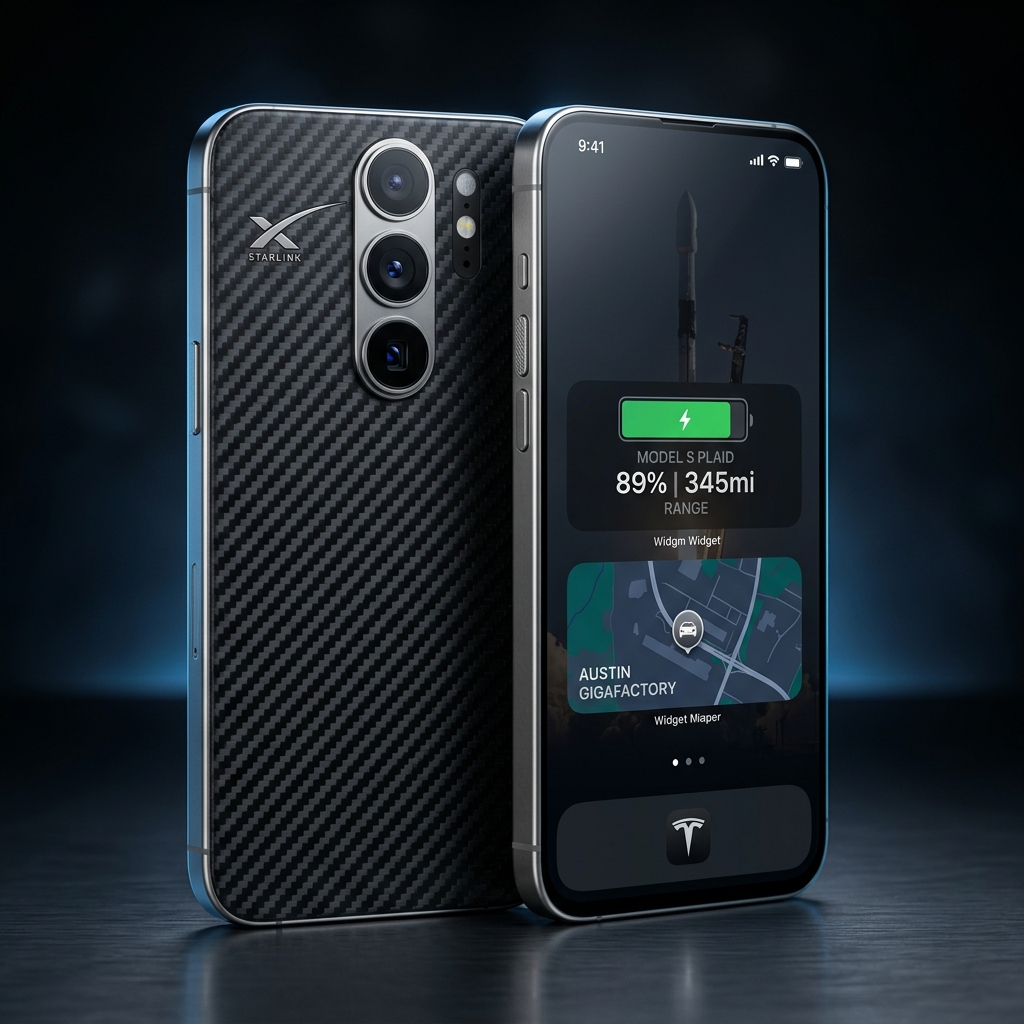
Let me be specific about what we actually know, versus what the internet has decided is true. Tesla has not officially announced a smartphone. Full stop. What we have is a collection of credible rumors suggesting Tesla and SpaceX are working on a device, internally referred to as the Model Pi, that would integrate natively with the Starlink satellite network, interface with Tesla vehicles, and potentially support early Neuralink connectivity features.
The pricing speculation hovers around $800 to $1,100 in the US market, which puts it squarely against the iPhone 16 Pro and the Samsung Galaxy S25 Ultra. In Europe, you'd be looking at roughly €750 to €1,050 depending on configuration and import duties.
The Starlink Angle Is the Only Thing That Matters
Every other feature being floated—the solar charging panel, the Mars-mode for future colonists, the alleged 200MP camera—I'll get to all of that. But the satellite connectivity story is the one that actually changes the competitive landscape. Right now, if you live in rural Bavaria or a remote area of Wyoming, your iPhone 16 Pro's Emergency SOS via satellite is a lifesaving feature, but it's not a productivity tool. It's an emergency backstop.
What the Tesla Phone is rumored to offer is persistent, usable internet via SpaceX's Starlink constellation. That's a completely different product.
"Apple has Emergency SOS. Tesla could have actual broadband. That's not a comparison, it's a category gap."
In my experience testing satellite-dependent devices, the bottleneck is almost never the hardware. It's latency management and software-layer buffering. Starlink has come a long way on latency, typically landing between 25ms and 60ms on Gen 2 hardware, which is genuinely usable for most tasks. If Tesla's software team can build a communication stack that intelligently switches between terrestrial 5G and Starlink based on signal quality, and does it invisibly, that would be genuinely impressive. I'm skeptical they'll nail this on the first generation. But the infrastructure is there in a way it simply isn't for any other phone maker on the planet.
| Metric | Detail |
|---|---|
| Starlink avg latency | ~40ms |
| Rumored base price | $800+ |
| EU market estimate | €750+ |
The Camera Claims: A 200MP Sensor Means Nothing Without the Software
Let's talk about the camera rumors, because this is where the hype machine really starts to outpace reality. A 200MP main sensor sounds spectacular. But here's what I've learned from testing the Samsung Galaxy S25 Ultra and various Xiaomi flagships that also threw enormous megapixel counts at the wall: more pixels don't mean better photos.
The Pixel 9 Pro shoots at 50MP and consistently outperforms 200MP sensors from competitors in real-world low-light scenarios, because Google's computational photography stack is simply better engineered. A 200MP sensor on a first-generation device from a company with no prior experience in mobile photography software is a marketing number until proven otherwise.
What I'd actually want to see is how Tesla handles night photography, portrait edge detection, and video stabilization. Those are the things that separate a good phone camera from a great one in 2026. Hardware megapixels don't. If they're smart, they'll license camera processing tech or acquire a computational photography company before launch. If they're not, we'll get another case study in how hardware specs don't equal user experience.
The Tesla Ecosystem Lock-In: A Feature or a Trap?
This is genuinely interesting territory. Tesla currently has over 6 million vehicles on the road globally. If the Tesla Phone integrates natively with those vehicles, we're talking about a built-in user base that rivals some mid-tier Android OEMs entirely.
Imagine a phone that:
- Auto-unlocks your car as you approach.
- Displays live range and charging status on the lock screen.
- Lets you pre-condition the cabin remotely with a single tap.
- Seamlessly hands off navigation from your phone to the car's display.
None of these features require breakthrough technology. They require tight software integration. And that's exactly what Apple CarPlay and Google Android Auto have been failing to do convincingly for years.
For German Tesla owners specifically, this is a compelling pitch. Germany has the highest EV adoption rate in the EU among major markets, and Tesla is a dominant brand in that segment. A phone that talks to your car better than any Android or iPhone can is a real differentiator. The question is whether Tesla wants to be a walled garden. Because the moment they lock critical features to Tesla vehicles only, they've cut themselves off from a massive potential customer base.
The Neuralink Integration: Stop. Just Stop.
I'll be brief on this one. The rumors that the Tesla Phone will support direct Neuralink brain-computer interface connectivity are, to put it charitably, very early. Neuralink is in its first human trial phases. Thinking that a consumer smartphone will ship with meaningful BCI support in the near term is the kind of thinking that makes for great science fiction and poor hardware forecasting. It might happen someday. It won't happen on version one. Don't let this headline appear in any buying decision you make in 2026 or 2027.
Solar Charging: Tiny Panel, Tiny Contribution
The solar charging panel is a nice idea, and I don't want to be entirely dismissive. But the physics here are unforgiving. A phone-sized solar panel in optimal sunlight conditions would charge your battery at a rate of roughly 1% per hour. That's better than nothing, and in a survival scenario it matters. For daily use, it's a curiosity.
The Motorola Defy Satellite Link already showed us that solar charging on a phone is a niche feature with a niche audience. Unless Tesla figures out a more efficient photovoltaic solution, this one's a bullet point in the brochure, not a reason to buy the phone.
"The solar panel won't charge your phone. It'll charge your imagination. And for most people, that's enough to put it in the press release."
The Real Competition: Can It Beat an iPhone 16 Pro?
Head to head against the iPhone 16 Pro at $999 or the Samsung Galaxy S25 Ultra at $1,299, the Tesla Phone needs to do more than match their core experience. It needs to be better at a few specific things while being acceptable at everything else. I've spent considerable time with both flagship competitors, and the bar is genuinely high right now.
The A18 Pro chip in the current iPhone is still ahead of Qualcomm's Snapdragon 8 Elite on sustained performance under thermal load, and Apple's software integration with iOS remains the benchmark for ecosystem coherence. Samsung has the hardware flexibility and the most mature Android camera system available today.
Tesla's only realistic path to carving out serious market share is through the Starlink connectivity angle for rural and international users, plus the Tesla vehicle integration play. Those two things together are a compelling differentiated proposition. Everything else needs to be competitive, not necessarily best-in-class. If they ship a phone that has reliable satellite internet, good-not-great camera performance, solid battery life in the 5,000mAh range, and seamless Tesla car integration, priced at $899 in the US and €849 in the EU, that's a product with a real audience.
Timeline Realism: Don't Hold Your Breath
Elon Musk has made ambitious hardware timelines his personal brand. The Cybertruck was promised for 2021 and shipped in late 2023. Full Self-Driving has been "next year" for approximately a decade. This isn't a critique so much as context.
If Tesla announces a phone at a high-profile event tomorrow, I'd put the actual consumer shipping date at 18 to 24 months out minimum. Hardware development, especially for a company without an existing mobile supply chain, takes time. And entering the smartphone market means competing with the most sophisticated manufacturing and distribution operations on the planet.
That said, SpaceX's engineering culture and Tesla's vertical integration capabilities are not nothing. When they actually focus on a hardware problem, the results are often genuinely impressive. The Starlink dish went from concept to mass-market hardware faster than most analysts predicted. There's no reason the same can't happen with a phone, if leadership commits to it.
Final verdict
The Tesla Phone, as described in every credible rumor, would be the most interesting smartphone concept since the original iPhone. The satellite connectivity play is real, the vehicle ecosystem integration is genuinely compelling, and the addressable market is bigger than most analysts acknowledge. But it doesn't exist yet. What exists is a marketing story that's doing the rounds, and a company with a history of announcing things before they're ready. Watch this space closely. Buy a different phone in the meantime.
Disclosure: This article is based on publicly available rumors and third-party reporting. Tesla Inc. has not officially announced a consumer smartphone product. Pricing estimates and specifications referenced herein are speculative. All competitor pricing reflects current US MSRP as of April 2026; EU prices are approximate market estimates inclusive of typical VAT at 20%.