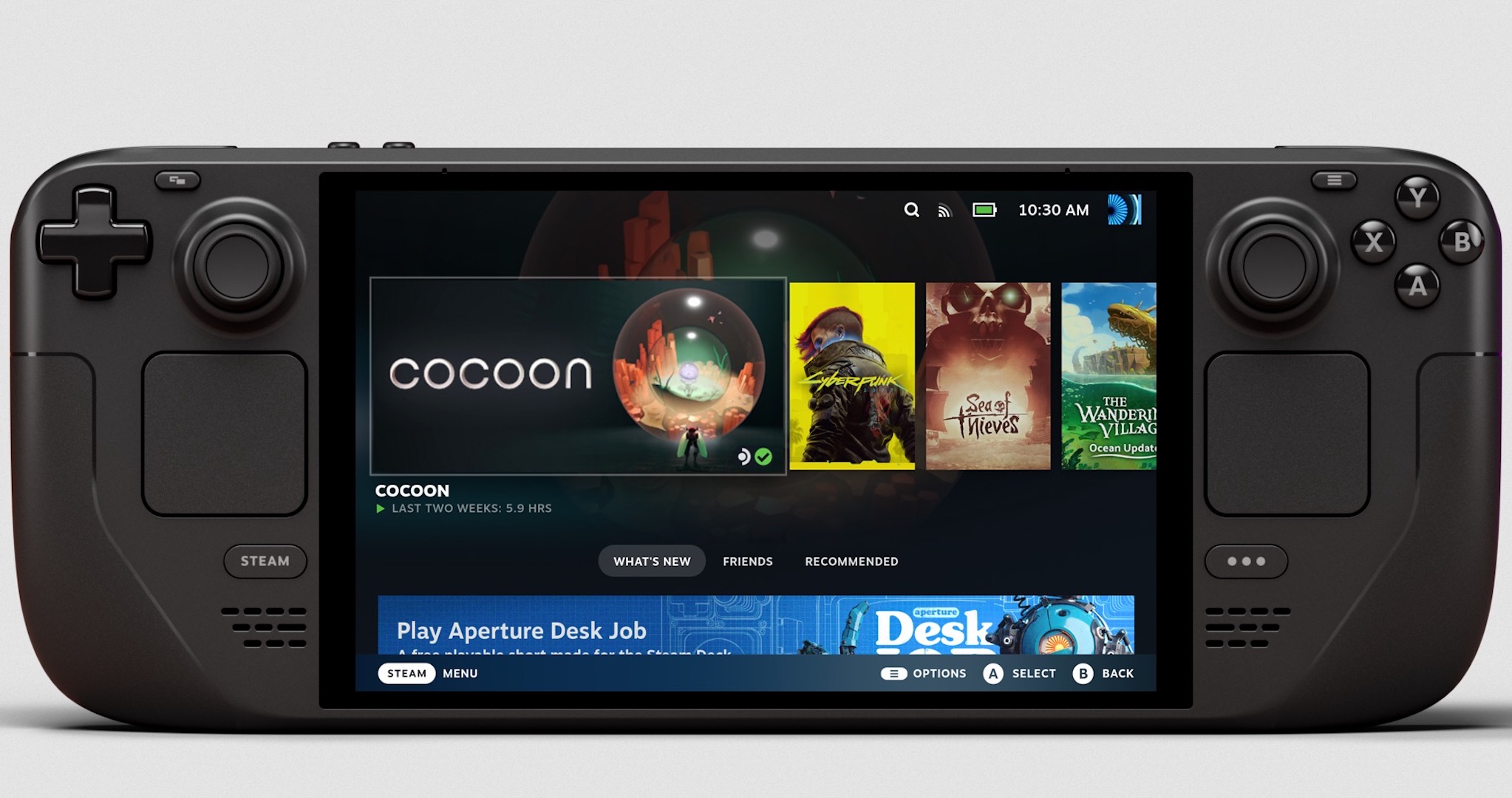
Valve has not officially announced a Steam Deck 2, but the evidence that one is coming continues to stack up. Developer interviews, credible hardware leaks, and the company's own public statements over the past two years give the gaming community a reasonably clear picture of what Valve is building toward and, just as importantly, why it's taking this long to get there.
Everything below is drawn from Valve's own statements, hardware analysis published by outlets including TechPowerUp, Tweaktown, PCGamesN, PC Guide, and Tom's Guide, and comments from known industry insiders. No hands-on hardware exists. Everything here reflects the best available evidence as of mid-2026.
| Detail | Current Best Estimate |
|---|---|
| Release window | 2028 (KeplerL2 leak, April 2026) |
| Processor | Off-the-shelf AMD APU, likely Zen 6 class |
| Display | OLED, 900p or higher, 90Hz+ |
| RAM | 24GB or 32GB LPDDR6 (expected) |
| Estimated price | $499 to $799 |
| Official announcement | None |
What Is the Steam Deck 2
The Steam Deck 2 is the anticipated second-generation version of Valve's handheld gaming PC. The original Steam Deck launched in February 2022 powered by a semi-custom AMD Van Gogh APU built on Zen 2 and RDNA 2. Valve followed that up in November 2023 with the Steam Deck OLED, which upgraded the display and battery but kept the same processing performance. The LCD version was officially discontinued in December 2025. As of mid-2026, the OLED model remains the current Valve handheld.
The Steam Deck 2 is intended to be a genuine generational performance leap rather than another iterative refresh. Valve engineers have described the bar clearly and repeatedly in public: the next device needs to deliver substantially more performance without giving up battery life or portability.
Steam Deck 2 Release Date
The most realistic window based on current evidence is 2028.
Hardware leaker KeplerL2 posted on NeoGAF in September 2025 pointing to a 2028 target. That claim was corroborated by multiple tech publications in April 2026 after TechPowerUp and Tweaktown covered it independently. According to KeplerL2, Valve is targeting a 2028 refresh for the second-generation Steam Deck, though ongoing DRAM and NAND Flash supply chain shortages could cause delays.
That 2028 window fits with what Valve's own engineers have said publicly. Valve designer Lawrence Yang told Bloomberg in November 2023 that a "next-generation power upgrade" wouldn't be available for "at least two or three years." Yang also said that while Valve thinks about Steam Deck 2 at all times, a big leap in technology would need to present itself before major progress is made.
In a January 2025 interview with Tom's Guide, SteamOS designer Pierre-Loup Griffais clarified that there are no current plans for a Steam Deck 2 using an AMD Ryzen Z2 chip. Griffais separately confirmed on Bluesky that "there is and will be no Z2 Steam Deck," ruling out a near-term refresh based on current AMD handheld silicon.
As of March 2026, Valve has still provided no concrete details about a Steam Deck 2. With the Steam Machine now occupying part of Valve's hardware roadmap, a handheld successor in 2026 is looking increasingly unlikely. Much like other major entertainment timelines that have stretched out, such as the GTA 6 release date on PC, hardware transitions require substantial engineering lead times.
Valve announced the original Steam Deck in July 2021 and began shipping in February 2022. If the same pattern holds with the Steam Deck 2, a 2028 launch would imply a public reveal sometime in 2027. Valve is notoriously unpredictable on announcement schedules, though, so that pattern shouldn't be taken as a guarantee.
How Much Will the Steam Deck 2 Cost
No official pricing exists. Estimates from multiple sources suggest a range of $499 to $799 depending on storage tier and final hardware configuration.
Space4games compiled Valve developer commentary and analyst sentiment to arrive at a $499 to $799 price range, noting that Valve does not want a Steam Deck 2 with just a marginal performance boost and that the jump should be substantial.
Earlier estimates, published before the more recent Zen 6 hardware leaks took hold, pointed to a sub-$500 entry price. But the class of hardware now being discussed for the Steam Deck 2 is considerably more powerful than the $399 original, and component costs at launch will have a major say in where Valve actually lands. The Steam Deck OLED launched at $549 for the 512GB model, and a proper next-generation device will almost certainly start above that. If that entry price is comparable to a custom PC build budget, you can plan your own desktop configuration using our interactive PC Build Checker tool.
Steam Deck 2 Specs: What the Leaks Point To
No specs are officially confirmed by Valve. What follows represents the current consensus across developer comments, credible hardware leaks, and technical reporting from the publications listed above.
Processor and GPU
The most significant design shift expected for the Steam Deck 2 is how Valve sources its chip.
The original Steam Deck used a fully semi-custom AMD Van Gogh APU that required bespoke engineering from AMD. According to the KeplerL2 leak reported in April 2026, Valve is moving away from that model and instead plans to use an off-the-shelf AMD APU, marking a notable shift from the original Steam Deck's custom processor approach.
Earlier leaks from Moore's Law is Dead pointed to an AMD APU codenamed "Magnus," based on Zen 6 architecture, as a leading candidate. This chip is also rumored to be powering the PlayStation 6 and next-generation Xbox, which would make it a high-performance APU relative to any handheld silicon currently on the market. (If you want to compare its rumored desktop-class architecture, see our guide on the best CPU for gaming).
A 2028 release window could align with AMD's rumored "Medusa Point" and "Medusa Halo" SoCs, which are expected to feature RDNA 4 and RDNA 5 graphics architectures alongside Zen 6 CPU cores and LPDDR6 memory support. AMD's AI-powered FSR 4 Super Resolution and Frame Generation technologies could be the key ingredient in delivering a notably more powerful Steam Deck 2 at comparable power draw. To see how current-generation desktop graphics cards measure up, check out our comparison of the RTX 4090 vs RTX 5070 Ti, or look at the best GPU for 1440p gaming under $400 in 2026 for more budget-friendly desktop options.
Valve's own design leads have publicly stated that a refresh with only 20 to 30 percent more performance is "not meaningful enough," confirming they're waiting for a more substantial upgrade before going to market.
Display
Based on a leak from Chinese tech forum Chiphell and compiled by Space4games, the Steam Deck 2 is expected to feature an OLED display running at 900p resolution and 90Hz, with OLED as the standard tier from launch rather than a premium upgrade option added later.
That would be a step up from the current Steam Deck OLED's 800p panel and position the device closer to competing handhelds. VRR support has appeared on community wish lists and would pair well with whatever upscaling framework Valve ships alongside the hardware. Higher resolution speculation reaching 1440p has circulated in Linux gaming communities but isn't supported by any specific hardware leak at this point.
Memory and Storage
The Steam Deck OLED ships with 16GB of unified LPDDR5 memory at 6400 MT/s. That's increasingly tight for modern PC gaming, with some titles already pushing past 16GB utilization on desktops. Community discussions and analyst commentary compiled by PC Guide point to 24GB or 32GB as the practical upgrade target for Steam Deck 2.
LPDDR6 memory support, which would come with Zen 6-class APUs, would significantly increase memory bandwidth compared to current specifications. That bandwidth improvement matters as much as raw capacity for gaming workloads on unified memory architectures.
Storage is expected to start at 512GB NVMe SSD at minimum, with 2TB as a possible upper tier. The microSD slot is assumed to carry over, given how central it's been to the platform's usability.
Battery Life
Pierre-Loup Griffais indicated to Tom's Guide that a 20 to 30 percent improvement in battery life would not be sufficient, implying Valve is targeting at least a 40 percent gain over what the current OLED model delivers.
The Steam Deck OLED brought battery capacity from 40Whr to 50Whr over the LCD model and extended real-world session times in the process. Real-world use on the OLED typically delivers between 1.5 and 6 hours depending on the game. The move to a more advanced process node for the APU, combined with FSR 4's ability to reduce GPU rendering load at native resolution, gives Valve real room to hit that 40 percent target without resorting to a physically larger battery cell.
Controllers and Build
Hall effect analog sticks are widely anticipated for the Steam Deck 2. The current model uses standard potentiometer sticks, which degrade over time and eventually drift. The community has raised this consistently, and competing handhelds are increasingly shipping Hall effect as standard. No official confirmation exists, but it would be a notable omission if Valve skipped them.
No credible leaks have addressed ergonomics, weight targets, or build material changes beyond the processor and display details discussed above.
How the Steam Deck 2 Compares to the Original
The original Steam Deck launched with AMD's Zen 2 CPU cores and RDNA 2 graphics running at 1 to 1.6 TFLOPS FP32, 16GB unified LPDDR5 RAM, and a 7-inch 800p IPS LCD. The Steam Deck OLED in late 2023 kept the same processing hardware and raised the ceiling on battery, display quality, and memory speed. Both run SteamOS, Valve's Linux-based gaming platform.
The Steam Deck 2 is expected to be a proper generation jump, not a refresh. Moving from Zen 2 to Zen 6 would be a four-architecture leap on the CPU side alone. RDNA 4 or RDNA 5 graphics are multiple generations ahead of the RDNA 2 currently in the device. In practical terms, games the current Steam Deck struggles to run, or can only run at low settings, could become fully playable on the Steam Deck 2 at native resolution without upscaling.
Steam Deck 2 vs the Competition
The handheld PC landscape changed substantially between the original launch and now. The ROG Xbox Ally (launched October 2025 through a Microsoft and ASUS partnership) and the Lenovo Legion Go 2 are the most prominent current competitors, both running Windows and off-the-shelf AMD silicon.
Community assessments and extended-use reviews consistently note that the Steam Deck OLED delivers better battery efficiency and a more optimized handheld experience compared to Windows-based competitors, even where the competing hardware wins on paper performance metrics.
Valve does not appear to be rushing Steam Deck 2 development in direct response to the ROG Xbox Ally, suggesting the company is comfortable with its longer development cycle regardless of what Microsoft-backed handhelds do in the short term.
The Steam Deck 2, arriving with dramatically stronger hardware on a platform Valve will have had additional years to refine, is positioned to be a significantly harder case to argue against at launch than the current model was in a less crowded market.
Valve's Philosophy Behind the Wait
Valve's approach to hardware development differs from most consumer electronics manufacturers. The company has said consistently, across multiple interviews with multiple engineers, that releasing the Steam Deck 2 with only marginal performance gains would undermine the platform's value proposition.
In a 2023 interview with Rock Paper Shotgun, Valve designer Lawrence Yang explained that the device needs to offer a fixed performance target for developers, and that changing the performance level is not something the company takes lightly. Yang stated that Valve only wants to move forward when there is a significant enough increase to be had, and that more performance should not come at a significant cost to power efficiency and battery life.
This isn't branding language. Griffais's multiple statements to The Verge and Tom's Guide reinforce the same engineering constraint: the current Steam Deck runs at a modest 15W TDP, and matching that efficiency level at dramatically higher performance requires process node improvements that take time to mature. Several Valve developers, including Pierre-Loup Griffais and Lawrence Yang, have stated they are waiting for a true technological leap. Smaller upgrades, like the Ryzen Z2 chip, are explicitly not enough for Valve.
Should You Wait for the Steam Deck 2
If you currently own a Steam Deck OLED, the 2028 window means there's no practical reason to hold off on using it. The device is receiving continued software support and runs the overwhelming majority of Steam's library well. Two-plus years of active use before a successor arrives is a reasonable return on a hardware purchase.
If you're deciding between buying now or waiting without owning a Steam Deck at all, the math gets tighter. The Steam Deck OLED remains a strong device with an excellent software ecosystem. Windows-based competitors have better raw specs on paper but come with software tradeoffs that aren't trivial for handheld-first use. Waiting until 2028 for a device with no confirmed price, specs, or launch date is a long hold for most people.
If maximum current performance matters more than ecosystem quality, the ROG Xbox Ally or Lenovo Legion Go 2 are viable alternatives today, accepting that their software experience is less optimized for handheld use.
Frequently Asked Questions
The most credible current estimate is 2028, based on a leak from hardware insider KeplerL2 published in April 2026 and corroborated by TechPowerUp and Tweaktown. Valve has made no official announcement, and supply chain disruptions with DRAM and NAND could shift the timeline.
Based on aggregated leaks and developer comments, the Steam Deck 2 is expected to use an off-the-shelf AMD Zen 6-class APU with RDNA 4 or RDNA 5 graphics, 24GB to 32GB of LPDDR6 unified RAM, an OLED display at 900p and 90Hz, and at least 512GB NVMe storage. None of these are officially confirmed.
Estimates compiled from developer commentary and analyst reports point to a price range between $499 and $799 depending on configuration. No official pricing has been set by Valve.
Yes, based on a Chiphell forum leak reported by Notebookcheck. The Steam Deck 2 is expected to ship with an OLED panel at 900p resolution and 90Hz refresh rate as standard, rather than as an upgraded tier added after launch.
If you don't currently own a Steam Deck, buying the OLED now is a reasonable decision given the 2028 expected window for the sequel. If you already own an OLED model, there's no compelling reason to wait rather than keep using what you have.
The ROG Xbox Ally runs Windows and uses current-generation AMD silicon, giving it a raw performance edge over the existing Steam Deck OLED today. The Steam Deck 2's expected Zen 6 hardware should close or erase that performance gap at launch, while SteamOS continues to offer a more refined handheld gaming experience than Windows for most users.
Hall effect sticks are widely expected by the community and analyst observers given competitive pressure and user feedback about stick drift on the current model. No official confirmation has come from Valve.
Valve's Pierre-Loup Griffais indicated in a Tom's Guide interview that a 20 to 30 percent improvement over current models isn't the target, pointing to at least a 40 percent gain over the Steam Deck OLED's battery performance as the internal benchmark.
All specifications, release windows, and pricing above are aggregated from Valve developer statements, hardware leaks from credible industry insiders, and reporting by TechPowerUp, Tweaktown, PCGamesN, PC Guide, Tom's Guide, and Laptop Mag. TheTechCompare.com has not tested any Steam Deck 2 hardware. All details remain unconfirmed until Valve makes an official announcement.